After Heartleaf, PDRN, and Retinol, What’s Next? Meet Hypochlorous Acid (HOCl), the Ingredient on the Rise
What do consumers look at most when choosing products that touch their face and body?
It used to be price or packaging first. Now more and more people are checking the ingredients carefully. Even hard-to-pronounce names like Heartleaf, PDRN, and Retinol get researched and compared before anyone decides to buy.
So what’s the next ingredient to watch?
It’s hypochlorous acid (HOCl).
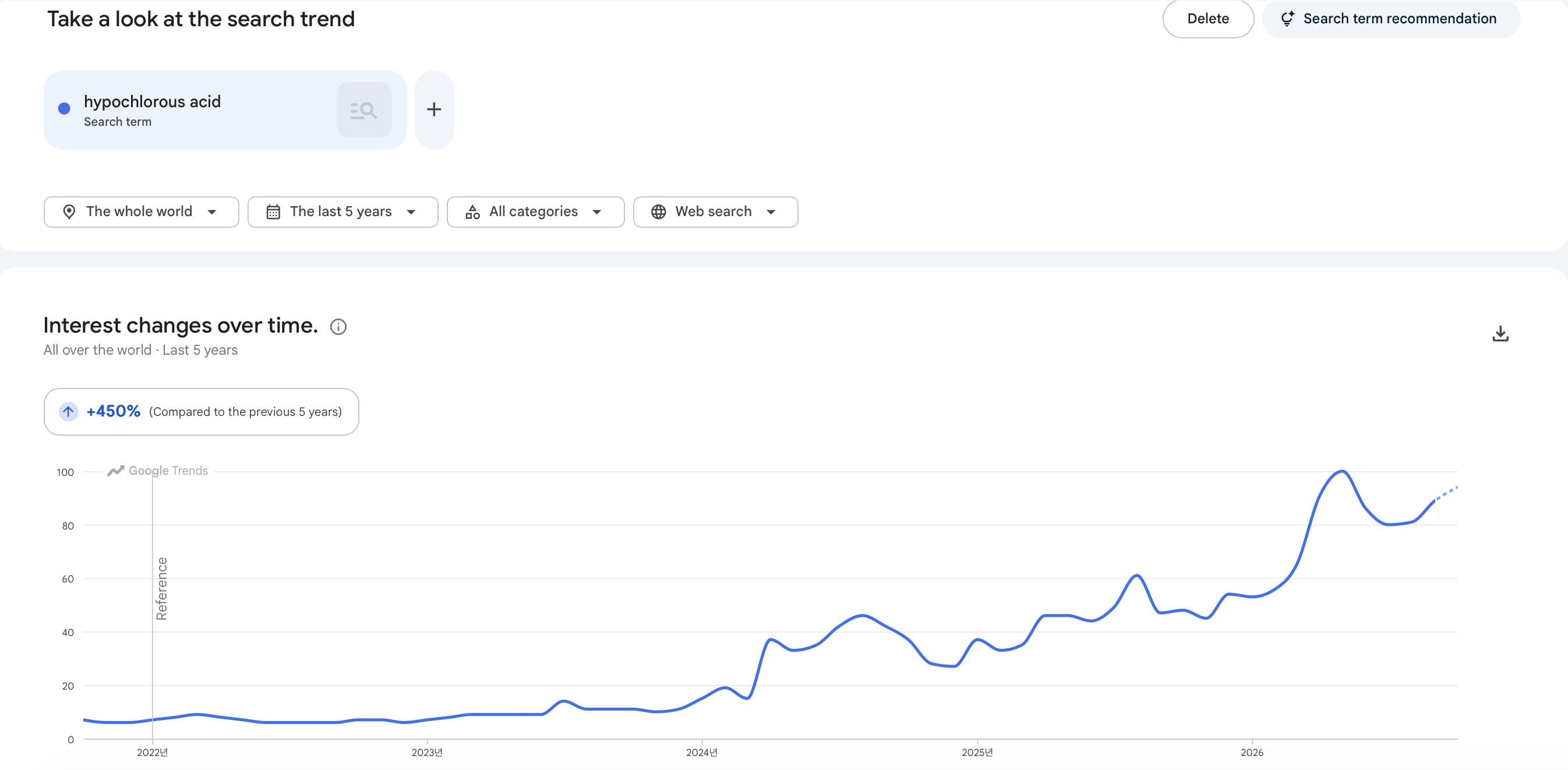
Google Trends shows that interest in this ingredient is growing worldwide. 📈
HOCl sounds complicated. Here’s the simple version.
Hypochlorous acid, or HOCl for short, is a tiny molecule that dissolves in water. The name may sound unfamiliar, but it isn’t foreign to your body at all. It’s a natural antibacterial substance that our own immune cells produce. It leaves little sticky residue and is body-friendly, which makes it a great fit for products you use several times a day.
Is it really that widely used?
The market numbers say yes. According to the October 2026 report from the global market research firm Future Market Insights (FMI), the cosmetic-grade HOCl ingredient market grew from about $85.1 million in 2025 to about $89 million in 2026, and is projected to reach about $139.5 million by 2036 (4.6% CAGR).
Products are multiplying fast, too:
🛒 In the U.S., HOCl skincare brands are sold at Target, Ulta, Amazon, and more than 1,000 specialty retailers.
🧴 In March 2026, an HOCl line for sensitive skin aimed at the dermatology channel was launched.
🏬 In August 2026, a major healthcare company introduced seven HOCl products to large retail chains such as Walmart, CVS, and Walgreens.
🏭 On the ingredient side, companies are acquiring HOCl manufacturers to control everything from production to packaging themselves.
Where do brands use HOCl?
HOCl is used in three main directions.
① Facial skincare (about 40% of demand)
Because it is water-based and leaves little residue, it suits mists and toners, leave-on products used several times a day.
② Anti-aging (about 32% of functional demand, the largest share)
It is formulated alongside wrinkle- and firmness-care ingredients and serves as a supportive partner that keeps skin comfortable in multi-functional products.
③ Sensitive and soothing care
It is considered the most direct use of HOCl, in products for reactive skin.
So what about Airreve?
Airreve’s Kool Up Large Shower Roll also contains hypochlorous acid ionized water.
With HOCl, how it’s made matters as much as what’s in it. Because it’s a water-based ingredient, water management during production shapes the quality.
✔ Ionized water made through a 4-stage water purification system
Airreve holds a patent for wet wipe manufacturing equipment that generates ionized water through a 4-stage purification process. Managing quality from the very first step of making the water is Airreve’s strength.
If you’re a buyer interested in HOCl products, please feel free to get in touch. We’ll be happy to share samples and detailed materials. 😊
Source: Future Market Insights, “Cosmetic-Grade Hypochlorous Acid Market” (October 2026)